
When the first big snow hits Anchorage, you want more than a cleared driveway—you want a smooth plan for the whole season. This guide breaks down how professional snow removal works for homeowners here: what’s included, how scheduling and pricing typically operate, and the extras (like de-icing and roof work) that keep your place safer all winter.
What’s Typically Included in Residential Snow Removal
Driveway clearing (plow or blower): Most services clear the entire driveway from the garage to the street, keeping berms manageable after city plows pass.
Sidewalks and entries: Walkways, steps, and porches are shoveled or blown to ensure a safe route for guests (and deliveries).
Ice management: Sanding or de-icing product applied to high-traffic areas—driveway aprons, steps, and steep sections.
Touch-ups after heavy storms: Many plans include a return visit when accumulations exceed your chosen trigger depth.
If you want a single provider that handles the lot, check out Be Happy Property Services’ snow removal in Anchorage. You can tailor scope and trigger depths to fit your property.
How Triggers, Routes, and Response Times Work
Snowfall triggers: You choose a start point (e.g., 2″, 3″, or 4″). Once the storm hits that depth, your service is activated.
Routing: Crews run planned routes that cluster nearby homes for speed and consistency. Corner lots or steep drives may be scheduled earlier to reduce the risk of icing.
Response window: Expect first pass during or immediately after snowfall ends, with follow-ups if winds drift snow back onto the drive.
Overnight storms: Crews often stage earlier and aim for a pre-commute pass; a second pass may follow if totals keep climbing.
Tip: Choosing a lower trigger means more visits and a consistently clean look, while a higher trigger saves on cost but accepts more accumulation between passes.
Equipment You’ll See (and Why It Matters)
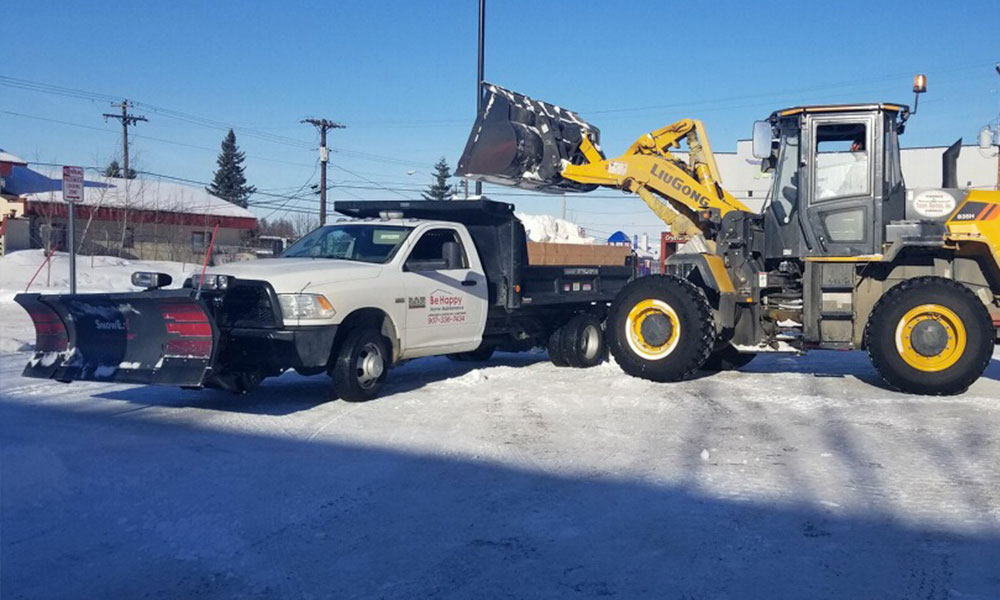
Truck plows: Fast for mid-to-large driveways; cutting edges can be set to protect compacted gravel.
Snow blowers: Ideal for detailed areas, tight drives, and minimizing berms.
Shovels and pushers: Stairs, decks, and tight landings get hand work for clean edges.
De-icing tools: Broadcast spreaders or targeted applications keep traction where you step first.
A well-equipped crew switches methods by area—plowing the main run, blowing edges near landscaping, and hand-clearing steps and thresholds.
De-Icing vs. Sanding: What’s Best for Anchorage Homes?
De-icing: Melts existing ice and helps prevent refreeze. Common on driveways, steps, and porches.
Sanding: Improves traction without melting; handy in deep cold snaps when de-icers are less effective.
Hybrid approach: Many homeowners choose a melt product for entries and a light sand for sloped sections.
Ask your provider which product is used where, and how often re-applications are included in your plan.
Roof Snow Removal & Ice Dams (When It’s Worth It)
Anchorage’s freeze-thaw cycles can produce ice dams along eaves, forcing meltwater to back up under shingles. Professional roof snow removal (with roof-safe tools and safety gear) becomes smart when:
- Snow depth on the roof piles up after repeated storms
- You spot icicles and water stains on the interior ceilings
- Your attic is warm and melts snow unevenly
Pros remove roof snow in controlled sections and open channels near eaves to help drainage. For a full winter plan that includes roof options, reach out to snow removal pros who offer add-ons for ice management.
What Counts as an “Add-On” Service?
- City berm knock-down after the street plow passes
- Deck and patio clearing for hot tubs or grilling areas
- Mailbox and trash-day paths so pickup isn’t missed
- Emergency one-off visits during travel or after a big drift
- Roof raking and ice dam mitigation during cold snaps
Confirm whether these are bundled or billed separately to avoid surprises.
Pricing Models You’ll Likely Encounter
Seasonal contract: Flat price for the whole season with defined trigger depths and visit caps. Great for budgeting.
Per-push pricing: Pay per visit, often scaled by snowfall range (e.g., 2–4″, 4–8″, 8–12″). Flexible for lighter winters.
Per-hour (specialty work): Roof snow, complex hand-work, or emergency calls.
Hybrid plans: Seasonal pricing for driveways + per-event pricing for extras like berms and roof clears.
Budget tip: If your driveway is long or sloped, share photos and measurements upfront. Clear scope = accurate pricing.
What a First Visit Looks Like
- Site notes: Crew confirms edges, landscaping, and obstacles.
- Pass 1: Main drive cleared and windrow pushed aside safely.
- Detailing: Sidewalks, steps, porch, and any add-on zones.
- Ice control: De-icer or sand placed where traction matters most.
- Final check: Gate access closed, garage apron tidy, and mailbox path open if included.
Homeowner Prep That Speeds Every Visit
- Move vehicles off the driveway before storms if possible
- Flag the edge of the drive and any low landscaping or drains
- Store hoses, toys, and planters away from plow paths
- Keep trash bins off the drive on service days
- Share gate codes and a contact phone for quick coordination
Small prep steps lead to faster, cleaner results.
Safety You Should Expect From a Professional
- Trained crews for winter conditions and night work
- Roof-safe tools for any overhead snow removal
- GFCI-safe practices for heated mats or corded gear
- Clear communication about icy areas and next-day rechecks
- Insurance coverage appropriate for residential work
If you prefer a service that handles operations end-to-end, Be Happy Property Services offers snow removal with driveway and walkway clearing, ice management, and winter add-ons.
Timing: How Fast After a Storm?
It depends on the trigger depth, the storm’s start/stop times, and your spot along the route. A common plan: first pass before the morning commute, then follow up later if totals keep rising or winds drift snow back. After major events, crews may return to reduce berms and reapply de-icer once temperatures stabilize.
Quality Checks You Can See
- Straight, full-width passes with clean edges
- Open the curb cut so you can enter the street safely
- Stairs and mailbox paths fully cleared (if in scope)
- Even de-icer coverage where foot traffic is heaviest
- No damage to turf, edging, or fences (and prompt fixes if something happens)
Common Anchorage Scenarios (and How Pros Handle Them)
Wind-loaded drifts: A second pass targets corners and garage doors where snow piles up again.
Deep cold snaps: Swap de-icer for sand to prioritize traction.
Back-to-back storms: Crews stage shorter intervals between passes to prevent compaction.
Refreeze on shaded drives: Spot applications and schedule tweaks reduce the risk of black ice.
How to Choose the Right Plan
- Driveway type & slope: Long or steep drives benefit from a lower trigger and more frequent visits.
- Household schedule: Early-morning commuters may want priority timing.
- Most-used entrances: Focus on de-icing where you step first.
- Add-ons you’ll actually use: Berm knock-down and roof snow are popular during bigger weeks; bake them into your plan if you know you’ll need them.
FAQs
1) What trigger depth should I pick?
Most homeowners choose 2″–3″ for steady, safe access. If your drive is steep or shaded, start lower to reduce compaction and ice.
2) Will a plow damage my driveway?
With the right cutting edge and operator technique, plows can be set to protect asphalt and compacted gravel. Edges are trimmed carefully around pavers and curbs.
3) Can I add a berm knock-down only after the city plows pass?
Yes—many providers offer this as an add-on visit or fold it into your plan after major storms.
4) Do you handle steps and porches, or just the driveway?
Most residential plans include sidewalks and entries; confirm exact areas in your scope.
5) When do you offer roof snow removal?
When depth and ice-dam risk rise. Crews use roof-safe tools and controlled sections to protect shingles.

Jacob Bishop is the founder and CEO of Be Happy Property Services. With a strong background in property management and customer service, Jacob has dedicated himself to creating a company that prioritizes client satisfaction and seamless property experiences. His extensive knowledge and hands-on approach have earned him a reputation for excellence in the industry. Jacob’s passion for real estate and commitment to happy living spaces make him a trusted leader in property services.